Why Do Some People Have Blue Eyes? The Scattering Answer
A blue iris contains no blue pigment; it contains a mesh of collagen fine enough to scatter short wavelengths back at the viewer. The physics and one regulatory switch account for most of it; the rest is a gradient.
Four layers, one decisive
The iris is a stack of tissues rather than a single film: an anterior border layer, a loose stroma, a thin anterior epithelium, and a posterior pigmented epithelium at the back. That rear layer is dark in essentially everybody, whatever the eye looks like from outside, and it explains two everyday facts. It is why a pupil reads as black rather than as a window, and it is why the pale front of a blue eye does not make the eye transparent. The difference between a brown eye and a blue one lives entirely in the tissue in front of that dark backing.
The tissue in question is the stroma, a loosely packed mesh of collagen and a scattering of pigment cells rather than a solid sheet. It is open enough that light entering the iris travels some distance inside before it leaves again, and that openness is the property that matters optically. In a heavily pigmented stroma the light does not get far. In a stroma carrying almost no melanin it does, and whatever returns has been through a scattering medium on the way out.
The scattering law behind the colour
John Tyndall demonstrated the effect at the Royal Institution in 1869 and presented it to the Royal Society under a title that reads like a statement of the whole problem: on the blue colour of the sky, its polarization and colour, and on the polarization of light by cloudy matter generally. Shining a beam through a glass tube while he filled it with smoke, he saw the beam blue when viewed from the side and red when viewed end-on. The short wavelengths had been turned towards the observer, and the long ones had carried straight on.
Lord Rayleigh supplied the arithmetic two years later: scattered intensity falls with the fourth power of wavelength. Violet light at 400 nanometres returns roughly nine times as much of itself as red at 700 nanometres does. Particle size decides which rule applies. When the scatterers are far smaller than the wavelength, below about a tenth of it, the fourth-power relationship is clean. Through the band from roughly 40 to 1,400 nanometres the effect is looser and carries Tyndall's name. Once particles grow beyond about twice the wavelength, the preference for blue collapses, which is why cloud droplets look white rather than blue.
The collagen fibrils of the iris stroma sit inside that scattering band. They are delicate, bundled in fibres under 100 nanometres across, and arranged loosely rather than packed tight, so the stroma behaves optically like a fine suspension. Short wavelengths come back to the viewer. Longer ones pass through and are absorbed by the dark posterior epithelium instead of returning. The blue a viewer sees is therefore not stored anywhere in the tissue.
Why brown, green and hazel look that way
Melanin absorbs broadly across the visible spectrum, and where it sits at the front of the iris it absorbs before scattering can be seen. That is why brown eyes are brown rather than blue: the dark pigment in the stroma removes short wavelengths on the way in, so the light that returns is dominated by longer ones. A brown eye is coloured by a pigment. A blue eye is coloured by a structure, and only the structure can honestly be described as having no colour of its own.
Green sits between the two cases. A green iris is otherwise a scattering iris with a small amount of melanin present, and returned blue light mixed with the longer wavelengths that survive the pigment reads as green. Hazel is usually described as brown sitting over a lighter rim, with the brown extending outward from the pupil. The same iris can also seem to change shade between rooms, because widening the pupil changes how much stroma the light crosses before coming back, and because the surrounding light changes what the eye is comparing the colour against.
What varies is the amount of melanin
Newborns give the most direct evidence that this is a quantity rather than a switch. Melanin production in the iris is not complete at birth, so a baby's eyes show the scattering colour whatever they will settle into later. Pigment accumulates over the following months, and the colour usually stabilises within the first year, though it can keep shifting for two or three. One inherited constitution therefore produces a different appearance at three months and at three years, which is what a trait built on pigment deposition should do.
The strongest single handle on how much melanin arrives is one letter change, rs12913832, inside an intron of HERC2 on chromosome 15. That region acts as a long-range enhancer which loops over to the promoter of the neighbouring pigment gene OCA2 and raises its output; the derived variant weakens the loop, so less OCA2 product is made and the stroma stays pale. Hans Eiberg and colleagues in Copenhagen reported in 2008 that the variant sits on one shared stretch of DNA in blue-eyed people sampled as far apart as Denmark, Turkey and Jordan, and dated the change to roughly 6,000 to 10,000 years ago.
What the entries record
The phenotype catalogue grades iris colour instead of reducing it to two settings. Proto Nordid is recorded with blue, green or grey eyes. Fenno Nordid is recorded with light, often water-blue eyes. Aisto Nordid is recorded with blue or grey eyes, and Borreby with blue or mixed eyes. A vocabulary with that many terms is describing a continuum that observers were trying to split, which is what an optical effect with a variable amount of pigment in front of it should look like when somebody tries to write it down.
The northern entries are also not uniformly blue, which is the point worth keeping. North Lappid, extending from Finnmark across northern Finland to the Kola Peninsula, is recorded with brown eyes. North Atlantid, the principal element recorded in Ireland and western Scotland, is recorded with brown or black hair and light, often blue eyes. Latitude sets how often a variant turns up in a region. It does not set the eye colour written into an entry, and it does not tie iris colour to hair colour, even though both run on melanin.
What the largest study added
The largest eye-colour study to date appeared in Science Advances in 2021, by Mark Simcoe and colleagues, covering up to 192,986 participants of European ancestry from ten populations. It reported 124 independent associations across 61 genomic regions, 50 of them previously unidentified, and those common variants together explained 53.2 percent of the variation, with a confidence interval from 45.4 to 61.0 percent. A further 1,636 participants of Han Chinese and Indian ancestry showed a similar genetic architecture at smaller effect sizes. Some of the associated genes govern pigmentation and others govern the morphology and structure of the iris, which means the geometry of the scattering mesh is itself a variable.
Forensic prediction draws the same line. The IrisPlex panel, described by Susan Walsh and colleagues in Forensic Science International: Genetics in 2011, reads six markers in six genes, including HERC2 and OCA2, from about 31 picograms of DNA, close to six diploid cells. It predicts blue and brown well and intermediate colours considerably worse, with reported success in the low nineties for the two extremes and nearer three quarters for green and hazel. Prediction is strongest exactly where the optics is simplest. Where scattering and pigment are mixed, both the eye and the model become harder to read.
One region, and a drifting map
The variant is commonest around the Baltic and thins out with distance from it, which is why the catalogue's lightest recorded eye-colour lines belong to northern entries such as Aisto Nordid and Fenno Nordid. The 2021 study notes that the prevalence of blue eyes correlates with latitude across Europe, most plausibly through migration combined with sexual and possibly natural selection, and adds that European populations, or those with partial European origin, show the widest range of iris colour of any group sampled.
What changes fastest is not the variant but who meets whom. In the third National Health and Nutrition Examination Survey, 57.4 percent of non-Hispanic white participants born between 1899 and 1905 had blue eyes; among those born between 1936 and 1951, the figure was 33.8 percent. Mark Grant and Diane Lauderdale, writing in Annals of Human Biology in 2002, attributed the fall mainly to declining assortative mating by ancestry rather than to any shift in the genes. The variant itself did not change. The pool of variants it was being mixed with did.
So the answer to why some people have blue eyes has two halves that do not depend on each other. The optical half holds for anyone: a pale stroma, collagen fine enough to scatter short wavelengths, and a dark layer behind it absorbing whatever is left. The genetic half is a variant that appeared once and is unevenly distributed, which is why a frequency can be mapped onto a region while a person's eye colour cannot be read off a map. The catalogue does the first and declines the second, and its entries stay anchored to distributions recorded roughly 1,500 years ago.
Frequently Asked Questions
- Is there any blue pigment in a blue eye?
- No. The iris contains no blue pigment, and the blue a viewer sees exists only as scattered light. The stroma of a blue iris is a loose mesh of collagen fibrils under about 100 nanometres across, and particles of that size return short wavelengths far more strongly than long ones. Longer wavelengths pass through the stroma and are absorbed by the pigmented layer at the back of the iris instead of coming back. Flatten a blue iris and it would read as translucent, not blue.
- If blue eyes are recessive, will they disappear?
- Not on the genetics alone. Recessive variants can persist in carriers for generations without showing, so frequencies fall slowly under mixing. What the data show is a fall in frequency: in US survey data, blue eyes dropped from 57.4 percent of non-Hispanic white people born around 1900 to 33.8 percent of those born in the 1930s and 1940s, largely because people stopped marrying within one ancestry. A falling frequency and extinction are different claims.
- Why can eye colour be predicted from DNA only some of the time?
- Because the trait is more complex than the popular model. The strongest single marker explains most blue and brown eyes, and a six-marker panel predicts those two categories well. Intermediate colours are harder, with accuracy reported nearer three quarters. The largest eye-colour study found 61 genomic regions contributing, including genes involved in the structure and morphology of the iris rather than pigment alone. Where pigment and structure both vary, a genotype returns a probability rather than an answer.
Related Phenotypes
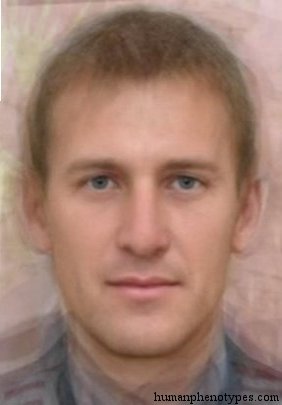
Faces from the encyclopedia that appear in this article. Open any entry for its full description, distribution, and references.
Proto Nordid
Northern Europe
Ancient East Nordid variety, the eastern counterpart of the Aisto Nordids. Together with early Mediterranids it was widespread in prehistori...
North Atlantid
Northern Europe
Western European type that combines features of Nordid and Mediterranid in a unique way. Resembles British Iron Age Celts. The principal ele...
North Lappid
Northern Europe
Northern Lappid variety, somewhat closer to Sibirid, possibly due to Samoyedic influence. Associated with Eastern Saami (formerly "Lapps"), ...
Fenno Nordid
Northern Europe
Ancient type of Northeastern Europe, sometimes placed in Nordid, sometimes East Baltid. Associated with Finno-Ugric people, once widespread ...
Test what you learned
Put your eye for regional faces to work in the daily quiz — a composite face, a world map, and your best guess.