What Race Am I? The Answer Was Always a Rule
The question reads like a measurement, but no system has ever measured race: it applied a rule of descent, asked a clerk, or let you tick a box. The same person can hold three answers at once.
A question shaped like a measurement
What race am I is built like what blood type am I. Both ask for a value that exists before the question, both imply a test that returns it, and both suggest that a competent technician could settle the matter in an afternoon. The second half of that analogy collapses on contact with the record. Blood type is read off antigens; race has never been read off anything. It has been assigned by a statute, entered by a clerk, or declared by the person answering, and each of those is a procedure rather than a reading.
The distinction is not wordplay, because the procedures disagree with one another and each one is internally consistent. A person can hold a legal category from a 1924 statute, a category a funeral director wrote down after asking a relative, and a box they ticked themselves, and all three can be true statements inside their own frame. Working out which procedure produced the answer in front of you is the only way to know what the answer could possibly mean.
The strictest statute on record
Virginia's Racial Integrity Act, passed on 20 March 1924, is the clearest case of race as an enacted rule. It recognised two categories, white and coloured, and defined a white person as one with no trace of the blood of any other race. Marriage across that line became a felony. The single exception was written for the descendants of Pocahontas: a person could be white with as much as one sixteenth American Indian ancestry, an accommodation for influential families, and it was narrowed in 1930 when Indigenous and African descent were folded into one category.
Enforcement fell to Walter Plecker, registrar of the state Bureau of Vital Statistics from 1912 to 1946, who checked birth and marriage registrations, wrote to county clerks who were too lenient, and warned midwives against false statements about a newborn's identity. The law was struck down in 1967 in Loving v. Virginia, and the statute itself was not repealed until 2020. The consequence outlived it: Virginia's Native nations could not document their descent and none received federal recognition until 2018. The rule did not describe a boundary; it built one and then erased the paperwork on the other side.
What the rule did to the count
Census categories follow the same logic, and the 1890 schedule makes it visible. That year enumerators were given mulatto, quadroon and octoroon alongside black, and the returns counted 6.3 million Negroes, of whom 957,000 were recorded as mulatto, 105,000 as quadroon and 70,000 as octoroon. The three finer categories were dropped in 1900 because the bureau judged them analytically useless. Mulatto returned in 1910 and 1920, then vanished for good in 1930, the year the instruction became that a person of mixed white and Negro blood was to be returned as Negro no matter how small the percentage.
No population changed to produce those shifts. A count is an output of the schedule, and the schedule is a set of decisions about which distinctions the state wanted to be able to see. When the instruction moved to hypodescent, the number of people recorded as mixed fell to whatever the form allowed, which was nothing. Reading a century of totals as a demographic history rather than as a record of changing forms is the most common way to be misled by them.
When the rule was removed, the boxes multiplied
The 2000 census was the first on which a respondent could mark more than one race, and the totals since then describe the instrument as much as the country. In 2010, 9.0 million people, 2.9 percent of the population, reported two or more races. In 2020 the figure was 33.8 million, or 10.2 percent, a rise of 276 percent in a decade. The Census Bureau's own commentary credits much of that jump to improvements in the two-question design and in coding, and warns against reading the comparison as pure demographic change.
That is the answer to the original question, stated as plainly as the data allows. A person who would have been returned as one thing under the 1930 instruction is returned as several things under the 2020 schedule, and neither return is a lie. The category is a position inside a classification, not a property carried in the body. Ask a different administration, at a different date, with a different form, and the correct answer changes without the person changing at all.
When no rule exists, a clerk supplies one
Most people assume their race is recorded from their own account. On a death certificate in the United States it usually is not. The item is completed by the funeral director from what an informant, often the next of kin, says, and in the absence of an informant it is completed from observation. The census, by contrast, collects self-report. Every mortality rate by race is therefore a ratio between two instruments that were filled in by different people under different rules.
Arias and colleagues measured the gap by matching death certificates against the National Longitudinal Mortality Study for 1990 to 1998. The share of decedents correctly recorded was 55.2 percent for American Indian and Alaska Native people, 88.1 percent for Hispanic, 89.7 percent for Asian and Pacific Islander, 98.1 percent for Black and 99.6 percent for White. Correcting the error reversed the mortality differential between White and American Indian populations. The misclassification was not random either: it shrank where the decedent lived near a large coethnic population, which is a description of who was available to be asked.
What a description can do that a rule cannot
A catalogue of documented appearance patterns sits outside all of this, and the difference is worth stating precisely. This one holds 209 entries and 1,465 references, about seven per entry, and an entry records a region, a set of observed traits, neighbouring patterns and the literature it came from. Bororo takes its name from the Bororo of Mato Grosso and the savannahs of western Bolivia. Baskid is tied to the Basques, recorded in its least mixed form around the Pyrénées-Atlantiques. Californid is an ancient coastal type now close to extinction, surviving among a few Yuki descendants. Arabian Veddoid is recorded among the Mehri of southern Oman and around Hadramaut.
None of those entries says what anyone is. They say where an observer worked, which traits were noted, and in which publication, and the distributions they describe are anchored roughly 1,500 years back. Movement since then is the ordinary condition of the record rather than an exception to it, which is why a person can match several entries loosely and none of them closely. That outcome is the expected result of centuries of migration layered over an older distribution.
What the question can honestly return
Three returns are available, and they are not versions of one another. If the category is legal or administrative, the answer belongs to whoever fills in the form, and the honest response is to name the form and the year. If the question is about descent, the instruments are documents and a genetic test, both of which report estimates with stated uncertainty and neither of which returns a single word. If the question is about visible traits, a catalogued description can answer it, provided it keeps its place, its period and its citation attached.
A quiz returns a fourth thing, and it is the smallest of the four: the distance between a pin and a documented centre on a map drawn from literature that is mostly a century old. That is a legitimate score for a game and a poor substitute for any of the first three. The question survives all of this, but only once it is rewritten to say which procedure is being asked to answer it.
Frequently Asked Questions
- Can a DNA test tell me what race I am?
- No. A genetic test estimates ancestry by comparing your markers with reference panels, and it reports that estimate with an interval. Race categories are administrative and legal objects that different countries define differently, so there is nothing in a genome for a test to match them against. A test can tell you that your markers resemble particular reference populations more than others. It cannot tell you which box a clerk, a statute or a form would have put you in.
- Why do my records say different things in different places?
- Because different records are completed by different people under different instructions. A census form is filled in by the respondent, a death certificate by a funeral director working from an informant or from observation, and a historical statute was applied by a registrar. Where self-report is the rule, a changed answer reflects a changed self-description. Where an observer supplies the entry, the answer tracks who was available to be asked and how familiar they were with the person's background.
- Does the phenotype catalogue assign a race to anyone?
- No. Each of the 209 entries describes a pattern recorded in a named region during a documented period, with the traits observers noted and the publications they wrote. The distributions are anchored roughly 1,500 years ago, before several large migrations rearranged them. An entry can tell you that a described pattern was recorded in a particular place and century. It cannot tell you what any living person is, and it is not built to try.
Related Phenotypes
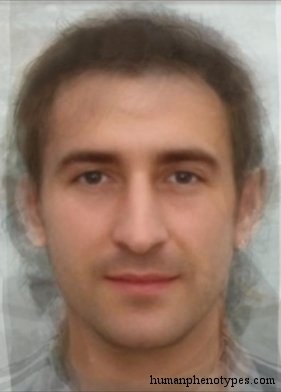
Faces from the encyclopedia that appear in this article. Open any entry for its full description, distribution, and references.
Baskid
Southern Europe
Ancient European type associated with the Basques. Found in its purest form in the Pyrénées-Atlantiques region of Southwestern France, altho...
Bororo
South America
The northernmost Patagonid variety, often mixed with local Lagid elements, but with a variety of unique features. Native to the savannah and...
Californid
North America
Ancient Margid subtype, probably arrived with one of the oldest migrations to America. Shares some features with Ainuids. During the last ce...
Arabian Veddoid
Middle East
Ancient Vedda-like type of the Arabian Peninsula and South Iran, often heavily mixed. Found in the Mehri of South Oman, around Hadramaut in ...
Test what you learned
Put your eye for regional faces to work in the daily quiz — a composite face, a world map, and your best guess.