What Is My Phenotype? The Catalogue Answers Trait by Trait
"What is my phenotype" has no single answer, because the catalogue keeps described characters rather than whole people, one at a time. Here is how to read 209 entries trait by trait, and where that stops.
The record stores characters, not people
The question asks about a person, and the file answers about characters. A phenotype is a set of observable characters, and the catalogue keeps it as a description of a distribution rather than a value belonging to anyone. The comparable part of each record is the block headed Physical Traits, present in all 209 entries, where skin, hair, eye form, stature, head form and build are written out. The remainder is provenance: where the pattern was recorded, and who wrote about it.
That structure decides what the question can return. The answerable version is narrower than the one that gets typed: not which entry matches a person overall, but which characters a given entry actually describes, and how coarse its vocabulary for each character is. The rest of this article works through the second half of that sentence, because it is the half that changes what a reader can honestly conclude.
How coarse the vocabulary is
Stature appears in every one of the 209 trait blocks, and the phrasings used for it collapse to about twenty distinct strings, with the word medium alone accounting for 42 of the 76 mentions. Head form uses more words but resolves to a small set of classes: mesocephalic in 51 entries, brachycephalic in 31, dolichocephalic in 28, with combinations covering most of the remainder. Skin colour is written out in 122 distinct strings across 218 mentions.
Those strings reduce further once they are read as a scale. The skin phrasings cover roughly five usable levels from pale through black, and the eye vocabulary is led by slanting, deep-set, mixed and dark rather than by any spectrum. A file that resolves stature at five levels cannot place a reader at 174 or 179 centimetres. The coarseness is not sloppiness: the sources were assembled to sort large samples quickly, and a vocabulary this coarse is what sorting large samples cheaply requires.
Three entries that split on one axis
Three European entries show what trait-level comparison does, because they separate on build and head form rather than on geography. Hallstatt, named for the Iron Age remains at the Austrian village, was separated out by Coon in 1939 and is recorded as tall and ectomorphic with a high, narrow face. Borreby, named for Neolithic skulls from Denmark, is described as tall and heavily built with a broad head. Gracile Mediterranid, first recorded in Mesolithic Natufian groups of Palestine, is the lightest-built European entry, rather short with narrow features.
One person can sit near Hallstatt on stature and near Gracile Mediterranid on pigmentation, because the two fields were measured separately and move independently. Borreby supplies a third combination, broad-headed with northern pigmentation. The coordinates keep the three apart in another way: 47.53 north for Hallstatt, 55.67 for Borreby, 32.26 for Gracile Mediterranid, recorded from samples collected decades apart for different questions. Comparing a character at a time is the only operation this file supports without inventing agreement between fields.
The character that moves fastest
Stature is the clearest case of a character whose value depends on when it was recorded. In 2016 a collaboration of around 800 researchers working with the World Health Organization compared heights in 200 countries between 1914 and 2014, covering 18.6 million people. South Korean women gained 20.1 centimetres, from 142.2 to 162.3, the largest rise in the study. South Korean men moved from 159.8 to 174.9, and Dutch men reached 182.5 centimetres, the highest national figure reported.
Movement ran in both directions. Several countries in sub-Saharan Africa recorded falls of up to five centimetres after the 1970s. A stature band written as medium or tall therefore belongs to the sample that produced it rather than to a region with a permanent value. Movement of that size inside one century is also why the entry has to be read with its date attached, since stature is strongly inherited and still shifted this far.
Distance runs to a mean
Every entry compresses a sample into a description, and the description is written relative to other entries rather than against an absolute scale. Brachio Melanesid is medium-height to rather short. Gracile Mediterranid is not merely small but the most gracile of the European entries. The North American record Mexicid is described as mixed across Maidu, Aztec, Maya, Yuma and Shoshone groups and as extending over an area from northern Guatemala to the Great Plains.
So a distance to an entry is a distance to a sample mean, and there is no boundary anywhere in the file. The coarseness compounds it: a mean recorded as medium for stature, with a spread the entry never states, cannot tell a reader whether their own value sits at the centre of the recorded range or at its edge. What the entry can supply honestly is one character compared at a time, together with the citation showing which sample that comparison came from.
A method that keeps the fields apart
The workable method follows the file's own organisation. Pick a character that can be described the way an anthropometrist would describe it: head form, hair form, stature band, eye form, skin tone band. Collect the entries whose trait blocks give the same value, and note whether each entry states a point or a range, since a range will match several entries at once. Then repeat for a second character recorded in a different field, and keep the two results separate rather than merging them into one impression.
Two checks finish the work. Compare the same character across entries to see whether the file has the resolution to separate them, and check whether an entry's distribution still covers the area you are looking at, given that migration after the documented baseline moved populations rather than descriptions. Where the two checks disagree, the honest conclusion is that the character falls inside the range of more than one documented pattern, and no single entry owns it.
What the question can return
What comes back is narrower than the question suggests and more usable than a label. It says which documented patterns a set of characters falls inside, how much of the apparent fit is an artefact of a five-value vocabulary, and which published work each comparison rests on. It cannot say which group a person belongs to, because the entries describe distributions with historical locations, and a living person is not a distribution.
Read as an atlas with a date on it, the file does what it was assembled to do. Its 209 records were compiled from published anthropometric work, anchored to places, and their bibliographies reach back to 1826. Asking whether a person belongs to one of them reverses the direction of that material. Asking which of its recorded characters a person's traits resemble keeps the direction intact and leaves the answer where the sources left it.
Frequently Asked Questions
- What is my phenotype?
- A phenotype is a set of observable characters, so the answer is a list rather than a single entry. Each of the catalogue's 209 records describes a documented appearance pattern with a place and a bibliography, and each carries a physical traits block covering skin, hair, eye form, stature and head form. Compare those fields one at a time to see which patterns your own characters fall within. The records describe historical distributions, not individuals or nationalities.
- Can this site tell me which phenotype I am?
- It cannot, and the records are not built for that. Each one compresses a sample into a description anchored to coordinates and a reference list, so what it holds is a documented pattern with a historical distribution rather than a class a person can be placed in. What the records do support is a comparison of single characters: whether your head form, hair form or stature band falls inside the range an entry describes.
- Why do some entries seem to describe me exactly?
- Because the vocabulary is coarse. Stature is written with about twenty distinct phrasings across 209 entries, and skin tone reduces to roughly five usable levels, so a description such as medium height with dark hair and dark eyes fits an enormous number of people. A close fit to one entry usually means the fit is also close to several neighbouring entries, and that overlap is the more informative result.
Related Phenotypes
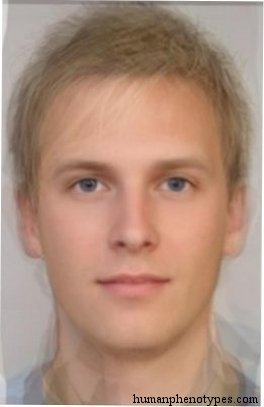
Faces from the encyclopedia that appear in this article. Open any entry for its full description, distribution, and references.
Hallstatt
Central Europe
Nordid proper, resembles the Iron Age remains of the Austrian village of Hallstatt. Most common among Swedes and South Norwegians. Frequent ...
Borreby
Central Europe
Ancient Northern European variety. Named after some of the Neolithic Borreby skulls of Denmark (not all!). Some emphasised resemblance with ...
Gracile Mediterranid
Southern Europe
Mediterranid proper, smaller than other Mediterranids: the most gracile type of Europe. Appears first in Mesolithic groups of Palestine (Nat...
Mexicid
North America
Margid proper. Probably arrived with one of the earlier migrations to America. Typified by Otomi, Purépecha, Pame, Pima of Mexico, as well W...
Test what you learned
Put your eye for regional faces to work in the daily quiz — a composite face, a world map, and your best guess.