Free AI Phenotype Scanner: What a Photo Can Supply
A photo carries hair form, iris colour and a rough skin tone, but not the cephalic, nasal or skelic class that nearly every catalogue entry is written in.
What a free scan actually returns
A free scanner in this category returns one of three things, and the three are not interchangeable. Some return a score on a short ordinal scale, usually a skin type numbered from one to six. Some return a single label chosen from a list the tool was trained on, with a confidence figure beside it. A few return a written description of individual features. Only the third is the same kind of object as a catalogue entry, because only the third says what was observed rather than where the face landed in somebody's list.
The price does not separate these outputs, since all three can run at no cost. Scope separates them, and scope is set by the descriptors the input can carry. A photograph of a face at conversational distance records some things very well and other things not at all, and the catalogue this site publishes is written in a vocabulary that leans heavily on the second group. Counting which words fall on each side is the most useful thing a reader can do before trusting any free result.
The entries are written in instrument units
All 209 entries in the catalogue grade the skull. The measure behind the words is the cephalic index, the greatest breadth of the head divided by its greatest length and multiplied by a hundred, with results below 75 called long-headed, 75 to 79.9 intermediate and 80 and above short-headed. Two hundred and six entries grade the nose the same way, using the nasal index, breadth over length times a hundred, with anything under 70 leptorrhine, 85 and above platyrrhine. Two hundred use a skelic class built from sitting height divided by standing height, and 177 add a term for vault height.
Each of those numbers requires a specific instrument and a cooperative subject. The cephalic index needs spreading calipers placed on the widest and longest points of the head, and on a living head the result includes scalp and hair, which is why measurements from living subjects and from dry skulls are not directly comparable. The skelic class needs a stadiometer and a stool. Tavastid makes the split visible inside one sentence, since the entry gives pale skin, straight blonde hair and light eyes, then adds brachycephalic and mildly hypsicranic, two classes that no photograph at any resolution will return.
Dinkaid and the words a camera skips
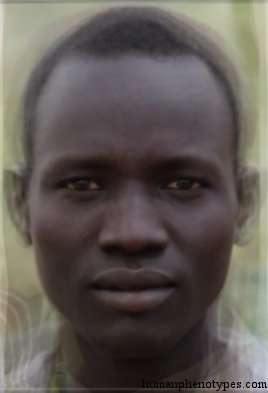
The Dinkaid entry is a compact test case. It records black skin and kinky hair, both of which a photograph carries, then continues with a list a photograph cannot address: hyperdolichocephalic, hyperbrachyskelic, extremely ectomorph with thin hips, recorded as the tallest of the catalogued patterns. The skelic term alone needs two measurements taken in different postures, standing and seated. Read the entry as a description and most of its words sit outside the reach of a phone camera, which is not a fault in the entry. It is what a document written by people holding calipers and a measuring rod looks like. A free tool that answers anyway is not lying about the picture, it is answering a narrower question, and the narrowing happened quietly at the point where the input was chosen.
What a frontal photograph does carry
Part of the catalogue's vocabulary survives translation into pixels. Hair form is readable as straight, wavy, curly or tight-curly, at least in the coarse bins the entries use. Iris colour is readable. An epicanthic fold is visible, though only 11 of the 209 entries mention one, which is worth remembering given how much weight the fold carries in popular descriptions of East Asian faces. Alar base width and visible prognathism register, subject to the next problem. Nesiotid adds a word no image resolves, since the entry describes light to medium brown, velvet-like skin, and velvet is a judgement made by touch.
Lens geometry supplies the next distortion. A phone held at arm's length uses a wide angle, and a wide angle close to a nose enlarges whatever is nearest to the lens. The same face photographed at two metres with a longer lens returns different proportions, so any figure a free tool derives from a selfie inherits the focal length along with the face. Standardised photography exists for this reason, and it requires a fixed distance, a fixed lens and a scale in the frame, none of which a casual upload provides.
Skin colour is the descriptor the camera edits
Pigmentation is the descriptor people expect a scanner to read, and it is the one a phone processes most heavily before anyone sees it. A JPEG leaving a modern handset has already been white balanced, tone-mapped, saturated and sharpened, and the white balance is chosen by an algorithm that assumes the scene contains something neutral. Tungsten light, open shade and midday sun produce three different files from one face. The CIE L*a*b* space, adopted in 1976, exists because device coordinates are not a reference space: it separates lightness from two chromatic axes so that a colour can be stated independently of the camera that recorded it.
A catalogue entry says light brown skin, or dark reddish-brown skin, and the phrase is a comparison against a reference series made by an observer trained to make it, not a value returned by a device. Khmerid is recorded as reddish medium brown, coarse wording that matches a coarse comparison. A scanner reporting warm undertones is describing a rendering, and the rendering changed the moment the light did.
The map moved after the entries were written
The catalogue describes distributions reconstructed for roughly 1,500 years ago, and the entries themselves admit how much of a pattern came from mixture. Khmerid is recorded as the result of intermixture followed by cultural brachycephalisation, with Cham, Sedang and Bahnar described as more mixed than the Khmer core. Nesiotid notes Europoid features in Polynesia while stating that no close genetic relationship exists. Both sentences point the same way: a described pattern is a record of what observers saw in a region at a date, and the people living in that region now include the descendants of everyone who arrived since. A photograph taken this year is matched against a map drawn for a different century.
This is where a free tool's convenience becomes a category problem rather than an accuracy problem. The tool compares a present-day image to a label set assembled from present-day images, then reports the result in the vocabulary of a historical catalogue the tool never read. The two halves of that sentence refer to different populations at different times, and no amount of model tuning reconciles them.
Using the answer for what it is
The practical rule is to ask which unit the answer is in before asking whether it is right. A score, a label and a description are three distinct claims, and only the description can be checked against the catalogue. A few habits keep a free scan in its proper place without dismissing it, and none of them requires technical training.
Name the unit first. If the output is a number on a six-point scale, it is a clinical skin type rather than a catalogue class, and the two were built for different questions. Ask for the descriptor instead of the verdict, since a tool listing hair form, iris colour and visible fold is reporting its input, while a tool answering with a people is reporting something its input cannot contain. Treat any pigmentation figure as a property of the file and re-shoot under different light before believing a difference between two images. Use the catalogue for the half a camera cannot reach, because cephalic class, nasal index and skelic proportion are written down with an author, a year and a region, and reading them costs nothing.
Frequently Asked Questions
- Why can a free phenotype scanner not give a cephalic index?
- Because the measure needs two caliper placements on the head, the greatest breadth and the greatest length, and a photograph contains neither a fixed scale nor a known camera position. Software can estimate proportions from an image, but the estimate shifts with focal length, head rotation and the distance to the lens, and the result is not comparable with the caliper values in the catalogue. On a living head those values also include scalp and hair, which dry-skull measurements do not.
- What can a free face scan actually detect?
- Hair form, iris colour, the presence of an epicanthic fold, visible jaw and lip features, and a rough impression of pigmentation. Each is a visible trait and each can be described. What the scan cannot do is convert those traits into a category from a historical catalogue, because the catalogue's categories were built from measurements taken with instruments, in a stated region, at a stated date.
- Does the accuracy figure on a free tool mean anything?
- Less than the number suggests. Accuracy is computed against whatever label set the tool was trained on, so it measures agreement with that set rather than with the catalogue or with any population. A tool can be 90 percent accurate at sorting images into four categories the reader never sees named. Ask for the label list before reading the percentage.
Related Phenotypes
Faces from the encyclopedia that appear in this article. Open any entry for its full description, distribution, and references.
Dinkaid
East Africa
Nilotid proper that shows the most pronounced Nilotic features: the tallest, most long-legged and one of the darkest phenotypes in the world...
Nesiotid
Polynesia
Mediterraniform Polynesid variety. Has been noted for its Europoid features, although no close genetic relationship exists. Typical in Samoa...
Tavastid
Northern Europe
East Baltid variety, typical for the eastern shores of the Baltic sea, similar to Neo Danubian and Borreby. Named after the Tavastia provinc...
Khmerid
Southeast Asia
Intermediate type between South Mongolid and Senoid native to Southern Indochina. The type is the result of intermixture followed by cultura...
Test what you learned
Put your eye for regional faces to work in the daily quiz — a composite face, a world map, and your best guess.