Face Ethnicity Analyzer: The Input It Was Built For
An analyzer is built for one frontal, unoccluded, evenly lit face, and ordinary photographs break that contract in structured ways that can be measured.
What the word analyzer assumes about its input
Every analyzer ships with an unwritten contract about its input: one face, roughly frontal, unoccluded, evenly lit, filling a known fraction of the frame. That contract comes from how the training sets were assembled. The large face corpora of the 2010s were scraped from celebrity photography and web images, which are mostly frontal portraits taken in good light by someone standing in front of the subject. Nothing in the pipeline records how often an ordinary photograph satisfies the contract. It is assumed rather than measured.
The assumption is reasonable for the images the model was fitted on, and unreasonable for what people actually submit: a selfie at forty degrees of yaw, a scarf, a surgical mask, a hood, a phone held close enough to bend the nose. When the input drifts, the model does not report a missing measurement. It returns a label from its fixed list with a confidence score attached. The failure is silent, which is the reason it is worth measuring rather than arguing about.
NIST measured what happens under a mask
In July 2020 the National Institute of Standards and Technology published the clearest available measurement, FRVT Part 6A, testing 89 commercial algorithms on about six million photographs with nine digitally applied mask shapes. Unmasked, the best algorithms failed to match a person roughly 0.3 percent of the time. With a mask, even the best rose to around 5 percent, and many otherwise competent systems failed between 20 and 50 percent. Accuracy fell further as nose coverage increased, and black masks degraded performance more than surgical blue ones.
Two cautions belong with those figures. First, the test measured identity matching rather than ancestry labels; both tasks read the same landmarks, so the mechanism transfers while the percentage does not. Second, the masks were applied digitally, which NIST stated plainly, so folds, shadows and the way cloth sits against a nose were never simulated. Real occlusion is worse than the benchmark, not better. By early 2021 a handful of retrained algorithms pushed masked error below 0.05 percent, which shows the contract can be widened at a cost.
Pose falls off a cliff at thirty degrees
Rotation is the second violation and the better documented one. On the MultiPIE benchmark, where the same subjects are photographed at fifteen-degree intervals, a standard deep model held 97.2 percent rank-1 accuracy at fifteen degrees of yaw and 92.6 percent at forty-five, then dropped to 62.8 percent at seventy-five and 34.2 percent at ninety. The pose-invariant literature converges on the same edge: methods hold up to roughly thirty degrees and degrade sharply beyond it, whichever architecture is used.
The Celebrity Frontal-Profile dataset isolates the extreme case, with 500 subjects and ten frontal plus four profile images each. Human verifiers fell from 96.24 percent on frontal-to-frontal pairs to 94.57 percent on frontal-to-profile, a loss of under two points. A convolutional baseline that matched people on the easy pair, 96.40 percent, dropped to 84.91 percent on the profile pair. People tolerate rotation without much effort. Models, unless trained specifically for it, do not.
A face is a surface read flat
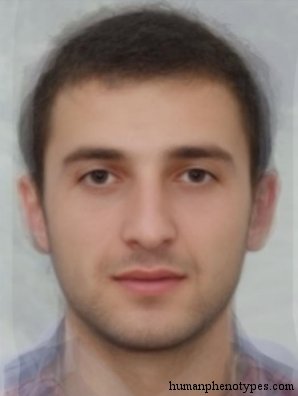
The underlying reason is geometric. An analyzer receives a two-dimensional projection of a three-dimensional surface, and rotation changes the projection without changing the surface. The nose suffers most, because its apparent width and its projection from the side are the quantities that move fastest with yaw, while the ratio the catalogue records stays fixed. An entry can note that a type has the lowest nasal index of its whole region, as the Mtebid entry does for the Caucasus, and no single oblique photograph can recover that index.
Lighting does comparable work from another direction. A frontal flash flattens the midface and erases the shadow that would show how far a brow projects; side light exaggerates the same projection. Automatic exposure then rescales everything, so the skin tone stored in the file depends on the background behind the sitter as much as on the sitter. None of this is random noise. Each effect is a systematic function of how the photograph was made, which makes the returned label a function of that too.
Garments are not features
The hardest cases are not partial occlusion but deliberate covering. A headscarf, a veil, a surgical mask or a hood removes the lower or the upper half of the face, and a classifier trained to emit one label from a fixed list has nowhere to put the missing half. It has no insufficient evidence class unless somebody built one, so the information loss is absorbed into the prediction. The same person photographed with and without a scarf can return two different labels, and the tool cannot say which one it stands behind.
The catalogue has the opposite problem, and the entries show it. Kachinid is described as a robust contact type named after the northernmost state of Myanmar, recorded from Kachin south through Karen, the Mergui Archipelago and deep into Indonesia. Yemenid is recorded from Yemen and Oman across to Sudan, the Rashaida and Madagascar, with a long history of admixture along the Red Sea. Both describe zones where several patterns meet. A single string cannot summarise one of those zones, and a covered face cannot support even that.
Two entries, one face, one string
The catalogue's own vocabulary concedes the mismatch, because its entries describe mixture as a normal condition: transitional, contact, blended, influenced by. Chukchid is an Arctic adaptation recorded among Koryak and reindeer Chukchi, and the entry notes an Itelmen subvariety heavily mixed with Russians today. Read one face against that description and the honest answer is a range with a probability attached rather than a category. An analyzer returning the modal label is reporting the peak of a distribution and presenting it as a fact about a person.
This is where the contemporary complication lands. Between 2020 and 2022 the deployed base of face images changed for good: masks became ordinary in exactly the photographs these systems were trained to read, and wide-angle front cameras became the default input. Neither change appears in corpora assembled before them. Models retrained after 2021 handle masks far better, which is good engineering and also a reminder that the label depends on the training window rather than on a stable property of faces.
Read the label as conditional on the crop
The practical rule follows from the measurements rather than from general scepticism. Ask what the crop looked like before reading what the label says. A frontal, evenly lit, unoccluded image supports a regional tendency statement, and this site's own composites are built to satisfy exactly that contract, which is part of why they behave well in tests. A tilted, masked or badly lit image supports very little, and the confidence score printed beside it is no substitute for knowing that.
The catalogue is the more conservative instrument for the same reason. It states a region and a period for a documented pattern and leaves the person out of the sentence. An analyzer compresses similar material into one word and drops the period, the region and the sample size along the way. Between the two, the sentence that still carries a date is the one a reader can check.
Frequently Asked Questions
- How accurate is a face ethnicity analyzer on an ordinary photo?
- There is no single number, because accuracy depends on how far the photograph departs from a frontal, unoccluded, evenly lit portrait. Published face benchmarks show that large rotations and covered lower faces cost double-digit percentage points, with some systems losing far more. An ancestry label is also a different task from identity matching, and the label list itself varies between tools. The honest reading is conditional: the same tool can be reliable on a studio-style image and unreliable on the next photo in the same camera roll.
- Why does a mask or a headscarf change the result?
- Because the classifier has a fixed list of outputs and no way to report a missing measurement. Covering the nose and mouth removes the landmarks that carry much of the geometric signal, and the model still returns its best-scoring label rather than declining. NIST measured the identity-matching version of this effect and found the best algorithms going from about 0.3 percent failure to about 5 percent, with many systems between 20 and 50 percent. Coverings worn by choice are therefore read as evidence rather than as absence of evidence.
- Does head pose really matter that much?
- It matters more than most people expect, because a person corrects for rotation without noticing. In the Celebrity Frontal-Profile dataset, human verifiers lost under two points moving from frontal to profile pairs, while a convolutional baseline lost more than eleven. On MultiPIE, standard models hold accuracy near fifteen degrees of yaw and fall away sharply past thirty. A selfie taken at an angle looks normal to the person who took it and looks like a different input to the model reading it.
Related Phenotypes
Faces from the encyclopedia that appear in this article. Open any entry for its full description, distribution, and references.
Mtebid
Caucasus
Regional type of the Caucasus Mountains. Probably an Alpinised Dinaro-Armenid adapted to life in mountainous regions. Mtebids are typical of...
Kachinid
Southeast Asia
Robust Proto Malayid subtype that probably originated in the Tibet/China border region and spread southwards some millennia ago. Named after...
Yemenid
Middle East
Orientalid subtype that deviates in an Armenoid direction. Most common in South and Central Yemeni. Also in Oman, UAE, Socotra, and parts of...
Chukchid
Siberia
Far Eastern Sibirid variety, influenced by Eskimid, adapted to one of the coldest inhabitable places on Earth: the Arctic tundra of Chukotka...
Test what you learned
Put your eye for regional faces to work in the daily quiz — a composite face, a world map, and your best guess.