Ethnicity Guesser vs DNA Test: What Each One Asks of You
The difference between a DNA test and a face quiz appears before either gives an answer: one asks for a sample and a signature, the other for nothing. Here is what each one takes, and what it hands back.
One asks for a sample, the other a guess
A consumer DNA test begins with a purchase and a wait. You order a kit, spit into a tube filled with a stabilising buffer, or rub a swab against the inside of your cheek, avoid food and drink for half an hour beforehand, seal the tube and post it to a laboratory. Then you wait, typically somewhere between three and eight weeks after the sample arrives, for a report to appear in an online account.
A face quiz asks for none of that. The catalogue behind this site is a fixed historical document: 209 documented appearance patterns, each with a region, a description drawn from the typological literature, and a composite image. Playing it means reading those entries and guessing where each pattern was recorded. No sample leaves your hands, because none is taken, and there is no upload and no laboratory anywhere in the loop.
What happens to a tube of saliva
Inside the laboratory the sample goes through a fixed pipeline. Cells are broken open with detergents, proteins are digested away, and the remaining DNA is purified onto a column or precipitated out of solution. Technicians measure how much DNA survived, because a thin or degraded sample fails quality control and triggers a request for a replacement. One detail surprises most people: much of the DNA in saliva does not come from the cheek lining at all, but from white blood cells that entered through the gums.
The purified DNA is then copied up and loaded onto a microarray, a chip that reads the letters at chosen positions called single nucleotide polymorphisms. The arrays used by the major ancestry kits read on the order of six hundred thousand to seven hundred thousand of those positions, out of roughly three billion base pairs in a human genome. The chip reads them in one pass, and the output is not a report but a long list of letters, which software then interprets.
The panel is the test's real instrument
The percentages on an ancestry report come from a second document that the customer never sees: the reference panel. A company recruits people whose recent ancestry is documented in one region, preferably with all four grandparents born there, genotypes them, and stores their profiles. Your own genotype is then chopped into segments, and each segment is assigned to whichever panel group it most resembles. The percentages are the totals of those assignments.
That design has a consequence worth knowing before comparing tools. Two companies with different panels and different algorithms can return different percentages for the same person, and the same company can revise an estimate when it updates its reference set. The number is therefore tied to a particular instrument at a particular date, which is why serious ancestry reports attach a confidence range rather than a single figure, and why the broad regional estimates hold up better than the fine-grained ones.
The quiz asks you for nothing
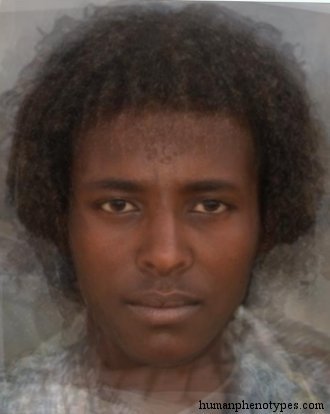
The catalogue this site publishes works the other way round: the instrument is fixed and shared, and the reader brings only attention. Every entry is a record. The Danakil pattern is placed in the Danakil depression of Eritrea and northern Ethiopia, described in the source as the hottest region on earth, with an annual average temperature above thirty-four degrees Celsius. The East Bambutid is the shortest type in the catalogue, an extreme rainforest adaptation recorded for the Ituri forest of the Democratic Republic of the Congo.
Others carry their naming history in the open. The Dinarid proper takes its name from the Dinaric Alps, and the record lists Serbs, Croats, Montenegrins and Bosniaks among the groups where it is commonly found. The Arabian Veddoid was named by Carleton Coon in 1939 and is recorded for the Mehri of southern Oman and communities around Hadramaut in Yemen. None of these entries claims to describe a living individual, and none is a percentage. Each is a named pattern with a place, a date and a source.
What the law says about a genome
A genotype is not only information, and the difference is written into law. In the United States, the Genetic Information Nondiscrimination Act of 2008 blocks health insurers from using genetic information to set eligibility, coverage or premiums, and blocks employers from using it in hiring and promotion decisions. The protection has visible edges: it does not cover life insurance, disability insurance or long-term care insurance, it exempts employers with fewer than fifteen employees, and it carves out the military.
The other edge is criminal investigation. In April 2018, an investigator working a decades-old California case uploaded a crime-scene genetic profile to GEDmatch, a free genealogy database where users publish their own profiles. The search returned more than a hundred distant relatives, including matches as close as a third cousin. Detectives reconstructed family trees from there, narrowed the field to a suspect, and confirmed it with a discarded sample. No warrant was needed, because the profiles had been uploaded publicly, which is the part that unsettled people.
Where the DNA test is the stronger tool
None of that makes a face quiz a substitute, and there are questions a DNA test answers better than any catalogue. It measures your own genome rather than a historical average, so its output is about you. It can identify living relatives by matching shared segments of DNA, which no image could do. It can be re-read as reference panels improve, and the health reports attached to some kits have been reviewed by regulators under a different standard from an ancestry estimate.
It also handles mixed descent more gracefully in one respect. A percentage breakdown can return several components at once, with a confidence setting that trades specificity for reliability, whereas a catalogue of patterns asks which single historical type a face most resembles. For someone whose recent ancestry spans several continents, the components are the more natural shape of an answer, even when each component is itself an estimate.
Two tools for two different takers
So the choice comes down to what you want and what you are willing to hand over. If the question is about your own descent, if you want to find relatives, confirm a documented line or work through a family mystery, a DNA test is the instrument for the job, and its legal protections are part of the product. If the question is about the world, and about how trained observers once described appearance across regions, a catalogue answers without asking for anything.
One caution applies to both. The reference panels behind a DNA estimate are built from people living in those regions today, and the catalogue describes a distribution as it stood roughly fifteen centuries ago. Migration since then has blurred both, so neither tool describes a fixed place on a stable map. Used honestly, a DNA test speaks about your particular descent and a catalogue speaks about a documented map, and neither is a verdict on who anyone is.
Frequently Asked Questions
- Does a DNA test tell you what you look like?
- Only weakly. It reads chosen positions in your genome, and some of those variants do influence pigment or build, but appearance is a joint product of many genes and of environment, so a genotype is not a portrait. Ancestry estimates are about similarity to reference panels rather than about features. No consumer test claims to reconstruct a face, and one that tried would be describing averages rather than you.
- Is a face quiz a free alternative to a DNA test?
- Not as a substitute, because they answer different questions. A quiz compares a composite image with a catalogue of historical patterns and asks where that pattern was recorded; it never reads your genome and never analyses your photograph. It costs nothing because it collects nothing. If you want information about your own descent, you need a test that measures your DNA, not a game that measures your map reading.
- Who can see the results of a DNA test?
- In the United States, the Genetic Information Nondiscrimination Act of 2008 limits health insurers and most employers from using genetic information. It does not cover life, disability or long-term care insurance, so those insurers sit outside its reach. Separately, public genealogy databases have been searched by police; in 2018 a crime-scene profile uploaded to one of them led to an arrest through distant relatives who had published their own data.
Related Phenotypes
Faces from the encyclopedia that appear in this article. Open any entry for its full description, distribution, and references.
Danakil
East Africa
Specialised Ethiopid type living in the hottest region of the world: the Danakil depression of Eritrea and Northern Ethiopia, with an annual...
East Bambutid
Sub-Saharan Africa
Bambutid proper: shortest pygmy type in the world with an extreme rainforest adaption that has evolved since the Middle Paleolithic. Histori...
Dinarid (proper)
Southeastern Europe
Central European type typical for mountain and forest regions. Presents the counterpart of Alpinids. The name derives from the Dinaric Alps ...
Arabian Veddoid
Middle East
Ancient Vedda-like type of the Arabian Peninsula and South Iran, often heavily mixed. Found in the Mehri of South Oman, around Hadramaut in ...
Test what you learned
Put your eye for regional faces to work in the daily quiz — a composite face, a world map, and your best guess.