Ethnicity Guesser Photo Free: Four Tests Before You Trust It
A free photo tool hands back one label and no sign of what else it could have said, which is exactly the gap a short test can measure.
A free result is one label
A free photo tool usually returns something short: one label, sometimes a number beside it, occasionally a line of encouragement. What it does not return is the shape of its own answer space. You are not told whether the model could have said twenty things or two hundred, whether the list came from a published taxonomy or from a meeting, or whether it is able to reply that nothing fits. Those omissions are what make the output hard to read, and every one of them can be probed from outside.
Testing costs nothing and needs no account. Four checks, run in an afternoon, separate a tool that is measuring from a tool that is guessing with confidence. They rest on the same principle as any calibration: put something through the instrument whose true value is already known, then watch what comes back. For a face tool the hard part is finding that something, because a photograph of a person does not come with a correct answer attached.
The error is not spread evenly
Face recognition is not one technology with one error rate. The National Institute of Standards and Technology measured 189 algorithms from 99 developers for its 2019 report on demographic effects, using 18.27 million images of 8.49 million people taken from government databases rather than scraped from the web. In one-to-one matching, false positive rates varied between demographic groups by factors of ten, and for some algorithms by more than a hundred. False negatives, the failures to match one person across two photographs, usually varied by less than a factor of three.
The asymmetry matters. The failures that scaled with group membership were the ones where a system declares two different faces to be the same face, and those were the large ones. An algorithm can look excellent in aggregate and behave very differently near the edges of its training distribution, which is where an unusual photograph sits. NIST tested algorithms rather than consumer products and did not assign causes, but it did show that one headline accuracy figure conceals the thing a user would most want to know.
Borrow a control with a known answer
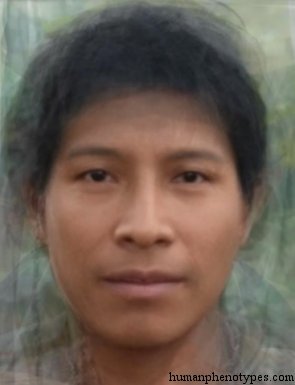
A composite face solves the missing-answer problem. Each image in this catalogue is built by aligning and averaging many photographs of a described pattern from a named region, so the correct region is settled before any tool sees the picture. No living person appears in it, which removes the consent question, and because the image is synthetic, a wrong answer cannot be read as a claim about anyone alive. It is a test object with a documented answer, published, and free to download.
The limits of that control deserve stating up front. A composite is an average, so it sits near the middle of whatever distribution it was built from. Passing on it shows that a tool can recognise the centre of a documented pattern. It does not show that the tool can place an individual, and it does not show that the pattern is a natural kind rather than an entry in a catalogue compiled by named authors in named decades.
Four tests, in the order that matters
Run them in this sequence, because each changes how much the next one is worth. A tool that fails the first is producing noise, and the rest of the hour is wasted on it. A tool that passes all four has told you the boundary of what any answer from it can mean. The whole protocol costs nothing and leaves you with four images and a note of what came back.
- Same file twice: submit the identical image, unedited, and compare the two responses. A label that flips means the output is driven by something other than the picture.
- Region before entry: feed one composite and ask only whether the returned label belongs to the same broad region. Entry-level agreement is a stricter demand than most tools can meet.
- Refusal: submit a chair, a hand, the back of a head. A system that always produces a face label is describing its output layer, not your upload.
- Count the answers: ask what the complete label list is. Five options and two hundred options are different instruments wearing one name.
- Re-encode and repeat: save the same image at lower quality and try again. If the label moves, resolution is carrying the result.
What passing the region test proves
Return the right region for the composite of South Amazonid, built from Tupian-speaking groups across Brazil and Paraguay, and that is a real result. Do the same for South Ethiopid from the corridor between Lake Victoria and Lake Tanganyika, South Bantuid from KwaZulu-Natal and Transkei, and Scando Lappid from the southern Saami areas, and you hold four controls spread over four continents. Agreement at that level says the training distribution contains those broad regions and that the label set can reach them.
It says nothing further, and the gap is worth naming. Those four were picked because they sit far apart, not because they are difficult. A tool can pass all four and still collapse the distinctions that matter inside a region, and it will do so without warning, since a label always arrives on schedule. The only way to see the collapse is to move from continent-scale controls to pairs of neighbouring entries, where the expected difference is smaller than the model's own run-to-run variance.
What the test cannot prove
A perfect score on composites shows that a pipeline is internally consistent. It does not show that its categories describe the world. The catalogue's baseline sits roughly 1,500 years back, and its sources were printed mostly in the middle of the last century, with a median dated reference of 1956 across 1,367 citations. The Scando Lappid record is unusually candid about drift: rare today, often mixed, and still common near Oslo around 1700. A composite built from that record depicts a distribution that has since thinned and moved.
Migration did the same to most entries. Cities absorbed their hinterlands, borders were redrawn, and the populations a 1956 monograph sampled are not arranged as they were when the surveyors arrived. A free tool trained on photographs from this decade is answering a different question from the one the catalogue asks, and neither answer is a statement about a living person's identity. The test tells you whether an instrument is consistent with itself. It cannot tell you that the categories it reports were ever natural kinds.
Reading a free label without overreading it
Treat a free label as a hypothesis about a photograph, produced by an instrument whose answer space you have partly mapped. Two habits follow from that. Ask what the label would mean if it were wrong, and if the answer is nothing, the label was decoration. Then keep the controls: re-running the same four composites every few months is the cheapest way to notice a model being swapped underneath a familiar interface, which happens more often than any changelog admits.
Frequently Asked Questions
- Is there a free ethnicity guesser that works from a photo?
- There are many, and the phrase covers tools with very different methods behind them. Some are interfaces to a general vision model given a prompt, some are open classifiers trained on a fixed list, and some read facial measurements against a published table. Free usually means the first tier returns a single label. Before trusting any of them, run a control image whose answer you know, check whether the same file produces the same label twice, and find out whether the tool can ever answer that nothing fits.
- What can I upload if I do not want to send a photo of myself?
- Use a synthetic face. Composite averages built from many photographs contain no real individual, so nothing personal is transmitted and no consent question arises. This catalogue publishes 209 of them, each tied to a named region and a printed source, which makes them unusually good test material: the expected answer is documented before the tool runs. Re-encoded stock photographs and images of objects work too, the latter mainly to check whether a tool is capable of refusing at all.
- How accurate is a free photo ethnicity tool?
- There is no single figure, and any tool quoting one is quoting something narrower than it sounds. Accuracy depends on how many labels the system can choose between, what region the photograph comes from, and whether the question is the broad region or a specific entry. NIST's 2019 evaluation of face algorithms found false positive rates differing across demographic groups by factors of ten to over a hundred depending on the algorithm. A free tier rarely publishes enough to place itself on that range.
Related Phenotypes
Faces from the encyclopedia that appear in this article. Open any entry for its full description, distribution, and references.
South Amazonid
South America
The most dynamic Amazonid variety, emerged in northern savannahs and spread south across Brazil to Paraguay and Argentina, pushing back olde...
South Ethiopid
East Africa
The southernmost Ethiopid, common between Lake Victoria and Lake Tanganyika, especially in Rwanda, Burundi, but also Uganda, Tanzania, and E...
South Bantuid
Sub-Saharan Africa
Bantuid variety, characterised by relatively wide skulls and robust faces. Especially found in the Kwazulu Natal / Transkei regions of South...
Scando Lappid
Northern Europe
Lappid proper - an ancient European type associated with Southern Saami people (formerly "Lapps"). Rare today, often mixed, typical in North...
Test what you learned
Put your eye for regional faces to work in the daily quiz — a composite face, a world map, and your best guess.