Ethnicity Face Scanner: Three Operations, One Word
A scanner measures a surface, a camera records light and a database returns a match, yet the ethnicity label a face page hands back is none of the three.
Three operations share the word scan
A flatbed scanner, a depth sensor and a police database all call what they do scanning, and the three outputs have almost nothing in common. The flatbed returns pixels at a stated resolution against a physical original. The depth sensor returns a surface in millimetres. The database returns a match, or a failure to match. A page that accepts a selfie and returns an ethnicity label is doing none of these three things, and that is worth noticing before the label is given any weight. What separates them is not accuracy or sophistication but the kind of object each one produces: an image, a measurement, or a decision.
What a depth scan has that a photo lacks
Depth sensing works because the device knows its own geometry. Apple describes the TrueDepth system on the front of its phones as projecting more than 30,000 invisible infrared dots onto a face and reading the pattern back; the projector and the camera sit a fixed distance apart, so the displacement of each dot converts into a distance. Time-of-flight sensors reach the same result by timing a pulse. Photogrammetry reaches it from several calibrated views of one object. All three routes end at a mesh with a scale attached, and the scale is the whole point.
Scale is what turns a shape into a measurement. Once the surface is in millimetres, head breadth and head length can be read off directly, which is what a pair of callipers did in 1900 and what a structured-light rig does now. The instrument changed; the two numbers did not. A single uncalibrated photograph has no equivalent step. Its pixels are a projection of a surface at an unknown distance through a lens of unknown focal length, and neither quantity can be recovered from the frame alone. Nothing in the file records how far away the face was.
Why the old literature counted ratios
This is why the historical catalogue is written in ratios rather than millimetres. The cephalic index divides head breadth by head length and multiplies by a hundred, which cancels the scale out. A skull measured in Paris and another measured in Uppsala can be compared even if neither instrument was ever calibrated against the other, because the result is dimensionless. The same arithmetic built the nasal index and the sitting-height ratio that the 209 catalogue entries still quote, and it is the reason the entries read as grades rather than as figures.
The trade is real. A ratio keeps the shape and discards the size, so a large head and a small head of identical proportions score the same. For the purpose these entries were built for, that was acceptable: the question was how round, not how big. For a photograph, the ratio is the only honest option, because the size was never recorded in the first place. What a photograph cannot do is return the millimetre figure a scanner would return, and what a ratio cannot do is turn itself back into a name.
A database scan needs a gallery
The third operation is a search. Biometrics separates verification, which compares one face against one stored reference, from identification, which compares one face against a gallery of many. Both require the gallery to exist before the scan means anything, and both require every entry in it to carry a label that somebody decided to attach. That enrolment step is where the difficulty sits, and it is not a software problem. Somebody has to decide who counts as a reference example of what.
The catalogue has an entry named Yakonin, and its history shows what a reference label can be. The name comes from yakunin, the Japanese word for a bureaucrat, because the type was associated with government and nobility circles; Weisbach defined it in 1878. The entry also records that Klenke identified it in 6 percent of Japanese Olympic athletes in 1938. A sample of Olympic athletes is a precise, unusual and entirely deliberate choice of people. A gallery built that way would answer questions about athletes, and the label would still read like a description of a country.
Europe already refused the naming version
The European Union drew its line at the output rather than at the input. Article 5 of the AI Act prohibits biometric categorisation systems that sort individual people from their biometric data in order to deduce or infer race, among several other protected characteristics. The prohibition has applied since 2 February 2025, and infringement falls in the highest penalty tier of the regulation: up to 35 million euros or 7 percent of worldwide annual turnover, whichever is higher. The target is a system that assigns a person to a category, not a record that describes a historical sample.
Two carve-outs sit in the same paragraph, and both are narrow. Labelling or filtering lawfully acquired biometric datasets is allowed, and so is categorisation inside law enforcement. Neither covers a consumer page that takes a stranger's selfie and hands back a category of people. Whether a given product falls inside the prohibition is a legal question rather than a technical one, but the shape of the rule is clear enough to be useful: what is regulated is the act of sorting a person, which differs from cataloguing a documented appearance pattern and stating where it was recorded.
What the returned word is made of
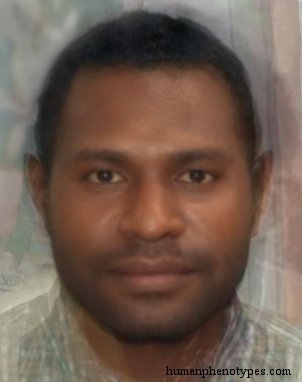
The label that comes back is usually a compound, and both halves show their work. Brachio Melanesid joins a shape word to an archipelago; its entry places the most pronounced form among the Kerewo of Goaribari Island in the Papua Gulf and a second centre in the Bismarck Archipelago. Desert Australid joins a climate to a continent. Yakonin joins nothing at all and borrows an occupation instead. Of the 209 entries, only four names contain a head-shape word at all, brachy- or dolicho-: Brachio Melanesid, Central Brachid, East Brachid and Indo Brachid.
Read that way, the output of a face page is a compressed sentence about a sample: here is a shape that was recorded in this place, in people who were measured, and written up by these authors. That is a modest claim, and it is the one a catalogue can actually support. It is not a claim about the person in the photograph. Central Brachid, to take one case, is described as possibly resulting from more Alpinoid migrations, which is a statement about movement into a region and not about anyone living in it now.
The scan and the map run on different clocks
The complication is time. A model trained on photographs from the last decade learns the categories that were in use when those photographs were labelled, and those categories are administrative. The catalogue describes a distribution roughly 1,500 years old, before the movements that built modern cities. Both are records of something real, and they are records of different centuries. A scanner asked to place a face on the older map is being asked to undo a thousand years of movement from a single frame.
The practical consequence is that a returned label is a statement about a training set, not about a person. What survives the mismatch is the part the catalogue was built to hold: a documented shape, a place where it was recorded, the authors who recorded it, and the year. Those four things can be checked against a library. A percentage cannot, and neither can a category that arrives without the sample it came from.
Frequently Asked Questions
- Is an ethnicity face scanner accurate?
- The question contains two separate ones. The first is whether the output matches the label set it was trained on, which can be measured and is usually decent on clean frontal photographs. The second is whether the label means anything about the person, which no accuracy figure can settle, because the label describes a documented historical pattern rather than an identity. A percentage answers the first question and is routinely read as an answer to the second.
- Can a phone measure my face in millimetres?
- Only if the phone has a depth sensor and knows its own baseline, as structured-light and time-of-flight systems do. A face-recognition camera can return a depth map in millimetres because the projector and the sensor are a fixed distance apart. An ordinary photograph cannot, since the distance to the face and the focal length are both unknown. From a single frame, only dimensionless ratios such as the cephalic index remain recoverable.
- Is a face scanner legal in the European Union?
- Article 5 of the AI Act prohibits biometric categorisation systems that sort individual people from their biometric data to infer race, among other protected traits, and the prohibition has applied since 2 February 2025. Narrow exceptions cover labelling lawfully acquired datasets and law enforcement. Whether a particular product falls inside the rule is a legal question, and this is a description of the provision rather than legal advice.
Related Phenotypes
Faces from the encyclopedia that appear in this article. Open any entry for its full description, distribution, and references.
Brachio Melanesid
Melanesia
Atypical brachycephalic Melanesid variety native to Melanesia and New Guinea. In its most pronounced form in the Kerewo of Goaribari Island ...
Yakonin
East Asia
East Asian type that has been associated with the ancient Japanese government and nobility circles. The name derives from yakunin (Jap.: bur...
Desert Australid
Australia
Australid desert variety adapted to the arid interior of Australia. Has furnished the general public idea of the typical Australian Aborigin...
Test what you learned
Put your eye for regional faces to work in the daily quiz — a composite face, a world map, and your best guess.