Best Ethnicity Guesser Site: Read the Page Before You Play
A best-of list compares products, but every product is a page you load. Three checks on the file itself decide what a site can do after the round.
A shortlist is a claim about pages
Anyone searching for the best ethnicity guesser site is handed a list, and every entry on that list is a page they will load. The screenshots decide most of the choice: the faces look good or they do not, the menu is long or short, the timer is there or it is not. Those are real differences between products. They are also the differences a picture is capable of showing, which is a narrower set than the differences that decide whether a site suits you after the first round ends.
Three properties stay invisible in a screenshot. Whether the answer already exists in the file before you press start. Whether the address will say the same thing next year. And whether there is anything left to read once the picture is gone. All three can be checked in about ten minutes with the browser you already have, and none of them requires playing a round. What follows is not a ranking. It is a way of telling which kind of object each site is, which is the question a list of names leaves unanswered.
Test one: load the page with scripts off
Turn JavaScript off, or open the page source and search it for the answer to today's round. Two outcomes are possible. The file may already contain the faces, the labels and the key, written out before the page reaches you. Or the file may contain almost nothing, a container that assembles itself once the browser starts executing code. Neither outcome is a defect. They are two different kinds of object, and the difference is old: a document that exists versus an application that runs.
The trade runs in both directions, and it is worth stating before any list. A document can be copied, quoted, archived, translated, and read by software that does not execute scripts, including the tools used by people who cannot see the screen. An application can do things a document cannot: hold a session, count attempts, and accept what a visitor sends. The second capability is not decoration. One of the best-known sites in this genre runs a mode that asks players to submit their own ancestry result and a photograph so that others can guess where they came from. No static file can receive a contributor's image; that arrangement needs a server that stores it, and the mode is a genuine advantage of the server page, not a gimmick.
How this site's own file is built
The site you are reading is in the first category, and the reason is in its configuration rather than in its marketing. The build is a static export: the last one wrote 361 HTML files into a folder, and serving those files is the whole of the deployment. Nothing executes on the server when you open a page, because there is no server program to execute. That is why the pages load fast from anywhere and why the site can be hosted on a file host at all.
The cost is exact and worth naming. There are no accounts here, no streaks, no stored history, and no place to upload a photograph. A player who wants a profile that remembers Tuesday's score is not served by this arrangement, and no amount of catalogue depth makes up for it. The honest way to read the comparison is that the two architectures buy different things: one buys permanence and legibility, the other buys the interaction that requires someone to keep your file. A list that treats those as points on a single scale has measured nothing.
Test two: what the address will mean
Daily games rotate. The address stays fixed while the content behind it changes, so a link to a round is a link to a particular morning and nothing more. That is fine for play and useless for citation. A record page behaves the other way: the entry keeps its name, its region and the works it was drawn from, so a sentence written about it still refers to the same thing in five years.
The check takes one click. Open any entry on a candidate site and look for a person and a year. North Indid, in this catalogue, is recorded as Type 2 by Eickstedt in 1920 and again in 1934, under a name Lundman kept in 1967, with Deniker's 1900 label Indo-Afghan and Risley's 1915 label Indo-Aryan attached to the same set of described traits. Katanga was named and separated from the Baykal type by Debets in 1951 and described in detail by Levin in 1963. Those clauses can be quoted, disputed and dated. A score cannot. A list that ranks sites by their rounds has ranked precisely the part that cannot be checked.
Test three: take the pictures away
The Web Content Accessibility Guidelines reached version 2.2 as a W3C Recommendation on 5 October 2023. Success criterion 1.1.1 asks that non-text content carry a text alternative, which sounds like a metadata chore until you apply it to this genre, where the picture is the question. An alt attribute reading composite face satisfies a checker and helps nobody. The substitute that works is the record itself, in prose, because that is the only form in which the round survives the loss of the image.
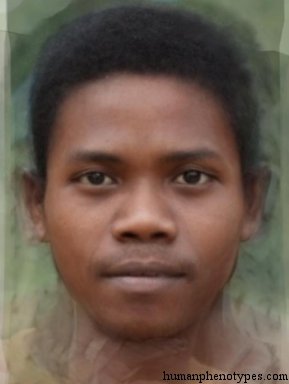
Semangid shows what that looks like. The entry places the pattern in the forests of the Malay Peninsula, distinguishes it from the neighbouring Senoids, notes roughly a thousand unmixed individuals remaining in relict populations, and traces the description through Skeat and Blagden in 1906 and Schebesta in 1927, who called it the Kensieu type and separated it from Jahai. A reader who never sees the composite still knows what the round is about, where it sits and who wrote it down. Compare a page whose entire text is an instruction to guess, followed by a JPEG. The difference is not accessibility compliance. It is whether the site has anything to say.
A frozen file is honest until it is not
A static export is a snapshot, and so is the catalogue underneath it: 209 entries describing distributions anchored roughly 1,500 years back. The two agree, and the agreement is also the limit. Andronovo-Turanid records that the type was probably more widespread before the expansion associated with Hunnic, Avar and Khazar movement, and that it is now most common among the Kazan Tatars. That sentence is possible because it is written in the past tense about a distribution rather than in the present tense about a population.
The distinction matters for what a page can promise. A frozen file can tell you what was recorded, where, by whom, and how confidently. It cannot tell you who lives in that region now, because the answer changed after the file was written and will change again. Half a millennium of movement sits between the record and the reader, and the twentieth century compressed more of it than any century before. For a player that gap is the game. For anyone reading a label as a statement about the people on their street, no format repairs it, and a site that implies otherwise is selling the gap as an answer.
Which arrangement suits which reader
A player who wants variety, themed rounds, a long evening, or a mode built on photographs other people volunteered is best served by a multi-mode site with a server behind it, and the contributed-photo mode has no equivalent here. A reader who wants to open the source behind a face, with a region, a period and a named author, is better served by a catalogue page that exists as a file. Someone testing whether a tool works at all should start with the script-off check, because a page that renders nothing without code is telling you what it is.
This site runs a quiz built on composite faces, so its preference for the document arrangement is not a neutral verdict. The rule that survives the comparison is not a feature count. Read the file, look for a name and a year, take the picture away, and ask what the address will still mean next year. A site that answers those four questions plainly is one you can reason about, whatever it turns out to be good at.
Frequently Asked Questions
- How can I tell whether an ethnicity guessing site works without JavaScript?
- Open the page, disable JavaScript in your browser's developer tools, and reload. If the faces, labels and answer key appear, the page exists as a document and everything you see was written before it reached you. If you get a blank area or a spinner, the page is assembled by code after loading. Both designs are legitimate, but only the first can be archived, quoted, or read by software that does not execute scripts.
- Does a site that requires JavaScript do something wrong?
- No. A server-backed page is the only way to accept a contributed photograph, keep a session, or remember a score, and one well-known site in this genre uses exactly that capability to let players submit their own ancestry results. The point of the test is not to grade the site but to know which kind of object you are using, because a document and an application fail in different ways and suit different questions.
- Can a daily quiz round be cited or checked later?
- Only with the date attached, because the address stays the same while the content behind it rotates. A catalogue entry is different: it keeps a region, a described set of traits and the works it came from, so a sentence about it still refers to the same record years later. If you need something you can quote in an essay, cite the entry rather than the round.
Related Phenotypes
Faces from the encyclopedia that appear in this article. Open any entry for its full description, distribution, and references.
Semangid
Southeast Asia
Paleolithic, Negriform phenotype found in the forests of the Malay Peninsula, similar to Aetid. Even older and rarer than the cohabitant Sen...
North Indid
South Asia
Indid subtype of Pakistan and Northwestern India, often associated with ancient Indo-Aryan migrations from the North. Common in Punjab, wher...
Katanga
Siberia
Western Tungid variety, influenced by Sibirid, but with several distinctive features differentiating it from both. Named after the Khatanga ...
Andronovo-Turanid
Central Asia
Northern Turanid variant, has probably been more widespread prior to the Tungid expansion of Hunnic, Avar, and Chasar tribes. Influenced by ...
Test what you learned
Put your eye for regional faces to work in the daily quiz — a composite face, a world map, and your best guess.